
Ask any serious film lover — like me — why The Godfather is great and you will receive an answer full of confident language: the performances, the cinematography, the writing. Ask them why a film with an equally good plot, an equally talented cast, and a similar budget failed to move them, and the answer becomes suddenly vague. Something was missing, they say. It didn’t feel real. It had no soul. Ask any art lover why Van Gogh’s shoes move you and not Dion Archibald’s shoes. The answer is simple: they carry a different frequency of the artist’s intention. Before I started writing this, I was in my room fumbling through my highlights of Wilson’s occult series, Mysteries (1978), but the balcony door was a bit ajar and one morsel of wind hit my face — like someone deliberately threw it over me — which pushed my memory to the distant past, as if I were listening to music that carried both feelings: melancholic and nostalgic. What was that feelings or Music?
And yes, they say of bad art or creation — that word, missing soul, is one of the most used and least examined phrases in the entire history of art criticism. Critics deploy it as though it explains something. It explains nothing. It is a placeholder for a mystery we have not yet been brave enough to fully investigate.
This essay is my attempt to investigate that phenomenon. It draws together three seemingly unrelated bodies of thought: the neuroscience of perception and emotion; the philosophical psychology of Colin Wilson — particularly his 1978 masterwork Mysteries; and the remarkable stone-emotion theory of Cambridge archaeologist T.C. Lethbridge. [When I first read his book I was mesmerised by this idea of Lethbridge, even if at some points it looks unconvincing.] Together, these three frameworks do not just explain why some art is great. They reveal something far more unsettling: that great art is not merely well-crafted. It is charged. It is alive in a way that mediocre art is not. When I was young and began to develop a taste for Van Gogh’s paintings, I was immediately connected with his colour and invocation. At that time, I had not read Wilson or anything like that, but I was craving something deep, for which I had no name. I was trying to create meaning out of this ‘staring’ into paintings and the ‘bald man’ [I am talking about Apocalypse Now, which I have written about in many works, and how much it influenced my earlier years of cinema taste] on cinema screens.
Before we can understand what great art does differently, we need to understand what the brain is doing when it encounters any art at all. When I was standing on the balcony and a ball of wind hit my face, I closed my eyes and felt something — maybe that primeval ‘utterance’ within the wind. That was the charge of nature. The wind carried me back to my childhood. I was standing on that long hill, feeling the same gushing wind on my face. Was this the same wind carrying the same ‘carbon-feeling’ in me? I was overwhelmed by that sensation. When Proust had been carried away by the smell of madeleine tea, I was carried away in the same manner by that ball of wind — it had the smell of evening fog-laden smoke in the village. The question is whether my consciousness was acute to the ‘remembrance,’ or whether it was related to Lethbridge’s stone-charge.
The brain is not a passive receiver. It is an extraordinarily active prediction machine. At every moment, it is generating a model of reality — filtering, compressing, and anticipating experience so that it can keep the body alive with minimum expenditure of energy. It is like digging to the right place in the brain with those ‘charges.’ And when it matches your expectation, it creates a chasm between the ‘ordinary’ and the ‘extraordinary.’ Neuroscientists call this predictive processing. The brain does not wait to see what happens. It is constantly guessing what will happen and only updates its model when something surprises it. The ball of wind on my face did not just surprise me but helped with that process.
This is why habit is the enemy of perception. The brain habituates to anything familiar. The commute you have driven a hundred times is processed on something close to autopilot. For example, when I travelled last week on a train, can I remember anything? Who was there? What was the actual atmosphere like? No, I cannot recall anything, but the brain had its way of storing that data. The song you have heard too many times stops being heard at all. The brain has learned the pattern and filed it away. It no longer needs to pay full attention. But after a few days, it was a rainy day; I was waiting for the same train, and suddenly I felt something — the picture was so vivid and clear, let’s call it over-the-pixel clear. I opened my notebook and wrote a poem describing the event from that day on the train. I was focusing on one focal point, and it worked like a ball of wind or Proust’s madeleine tea. One thing I realised that day, when I finished scribbling so fast, was that if I had written that poem the same day, it would not have carried the same emotion I was evoking in it — here, every word was compressed too deep and too perfectly. What is the reason? I am not being too academic here, but each word has a ‘charge’ — and most twenty-first-century psychiatrists believe that this ‘compressed charge’ holds a true beauty.
Colin Wilson, writing decades before modern neuroscience, called this mechanism the robot. He observed that human beings hand over more and more of their daily experience to this automatic processor, and in doing so gradually lose access to the full richness of conscious experience. We move through our days not fully awake. Not fully alive. We are, as Wilson put it, like a man who has hired a robot servant and then gone to sleep — only to discover the robot has quietly taken over the house. On the first day on that train, I was the robot, and after a few days, on that same train, I had somehow removed my robot mask and written that poem. Whenever great art or literature was created, there was this awakening.
Great art, then, is anything that wakes the man back up.
When the brain encounters something genuinely unexpected — morally, emotionally, aesthetically — it is forced to update its model of reality. Van Gogh didn’t invent potato eaters, but he experienced the farmers’ charge firsthand. The prediction machinery stumbles. And in that stumble, in that moment of recalibration, consciousness floods back in. The robot steps aside. The human being is suddenly, fully present. And great art strikes anyone because it has that ‘original’ stone-emotion.
This is what happens in the opening twenty minutes of The Godfather. Coppola does not give the brain what it expects from a crime film. There is no immediate violence, no crude establishment of menace. Instead, there is a wedding. It relaxes my mind. There is a family. There are warmth and music and the smell, almost, of food. The brain relaxes its guard. And then, slowly, it begins to sense something underneath — something cold and ancient and implacable — like when you stare at Van Gogh’s Shoes, which produces that vibration in your brain. The dissonance between the warmth on the surface and the darkness beneath forces the brain into a state of hypervigilant attention. It cannot look away. It is too busy trying to reconcile what it is seeing. You become too aware and write poems, or stare at paintings, or at cinema screens.
There is a moment in The Godfather — the first time I hear Nino Rota’s main theme — where something happens that has nothing to do with plot, character, or dialogue. A trumpet begins, soft and distant. A mandolin follows. The melody is simultaneously mournful and beautiful, nostalgic for something you cannot name, elegiac for a world that may never have existed — like when I had that ball of wind on my face earlier this evening, which gave me the same strange vibration, the same unknown sensation.
Your brain has no category for what it is feeling. Every year I go through this film twice, and every time Nino’s music plays, it is not quite sad. It is not quite joyful. It is something more complex — something I cannot even comprehend — what the Portuguese call saudade: a longing ache for something absent, something lost, something perhaps never possessed. When I wrote that poem describing the earlier commute from memory, I was trying to pull that saudade, perhaps. The brain, encountering an emotion it cannot label, does not dismiss it. It amplifies it. The unlabelled experience becomes more powerful than any experience that can be named and filed away — that is why the poem came suddenly without being labelled a memory or an experience; it was somewhere deep in the brain.
Nino Rota understood this intuitively. The first time I watched this film, the famous line “I believe in America” was not just exciting to me, but the music — over the opening credits and black screen [I have mentioned somewhere that I love to watch movies from the very first second] — that divinely beautiful trumpet solo, touched with sadness and at the same time carrying a hint of joy in that C minor, which we can find, if you have good taste in music, in most of the great valiant struggles in musical history. When the dying Vito slides off his car and onto the ground after being shot, the melody is played at a higher key — making the powerful line of music sound frail. Rota was not writing themes that explained what the audience should feel. [https://theseventies.berkeley.edu/godfather/2018/06/30/the-sound-of-nostalgia-nino-rotas-godfather-theme/] He was writing music that bypassed the brain’s labelling system entirely and spoke directly to what neuroscientists now identify as the limbic system — the emotional core of the brain that processes feeling before thought — that responds to sound before the conscious mind has had time to interpret it.
This is the crucial difference between functional music and eminent music. Functional music tells the brain what to feel. A horror film’s shrieking strings say: be afraid. A romantic comedy’s swelling strings say: this is the moment of happiness. The brain receives the instruction, processes it, and produces the appropriate emotional response. It is efficient. It is entirely forgettable.
Rota’s music does not instruct. It infects. It enters the brain through a side door — the same door through which smell triggers involuntary memory, the same door through which certain combinations of light and shadow can produce a sudden, inexplicable sense of dread or wonder. His melodies carry emotional information that the conscious mind cannot intercept and redirect. This is why, decades after seeing The Godfather, I can hear eight notes of that theme and feel the weight of the entire film descending on me. The music and the emotion have been neurologically fused. The emotion in the work is not manufactured. It was stored there.
T.C. Lethbridge was a Cambridge-educated archaeologist who, in his later career, became obsessed with a phenomenon his colleagues considered embarrassing: the apparent ability of certain locations, objects, and materials to retain and replay emotional impressions left by previous human beings.
Lethbridge had spent years using dowsing — the practice of using a pendulum to detect subtle fields — and became convinced through extensive experiments that organic and mineral matter could function as a recording medium for human emotion. A stone thrown in fury, he argued, retained something of that fury. A room where great grief had occurred would, under certain conditions of atmospheric humidity and the receptivity of the observer, replay something of that grief. He called these recorded impressions ghouls — not supernatural entities but emotional echoes, imprinted on matter by the intensity of human feeling.
Wilson, who wrote about Lethbridge at length in Mysteries, took these ideas seriously not because he believed Lethbridge had proven anything scientifically, but because Lethbridge’s framework illuminated something Wilson had independently observed: that intense human experience leaves traces. That the past is not simply gone. That consciousness, at moments of extreme emotional intensity, somehow reaches beyond the boundaries of the individual skull. [Fact: I stopped myself on these paragraphs for many minutes. I was not getting any ‘connected emotion.’ I feel like this sometimes — entirely disconnected from words. I was drinking and trying hard to get close to the emotion I was trying to write. Even though I played The Godfather in the background, it did not work. Wilson himself said that the moments of deepest insight come when you stop trying. The Faculty X — his term for that sudden sense of reality being fully present — cannot be forced, so I had to stop entirely, and I did come back after a few days and continued.]
For our purposes, the significance of Lethbridge’s theory is not its literal truth or falsity. It is its metaphorical and philosophical truth, which is profound.
Consider: what is a great work of art if not a Lethbridge stone?
Coppola, during the making of The Godfather, was under siege. The studio wanted to replace him. The production was chaotic. Brando was considered a reckless choice. Every day on set was an act of desperate creative courage from a man who believed he was watching his career collapse around him. That emotional intensity — the fear, the defiance, the love of the material — was pressed into every frame of the film like a handprint in wet clay.
Rota sat at his piano in Bari and felt his way into the soul of a family in decline, a son losing his innocence, a world where loyalty and betrayal were the same gesture. His sadness, his tenderness, his understanding of human moral complexity — all of it was stored in the notes he wrote.
The celluloid, the magnetic tape, the digital file — these are Lethbridge’s stone. The film carries the emotional charge of everyone who poured themselves into it. When you watch it, you are not just receiving information. You are coming into contact with stored human experience. Your brain, if it is in the right state of openness, detects this charge and responds to it — just as when Arjuna was in the right state of mind, he was ready to see Virat Rupa [it is like a universal-storing tape of consciousness, shown by Krishna himself]. The same thing happens to my brain when I listen to Nabin or Nino, or when I stare at Potato Eaters long enough — I can feel that enumeration of consciousness left in the universe, millions of years ago, in musical notes or in the sketches of a dead artist.
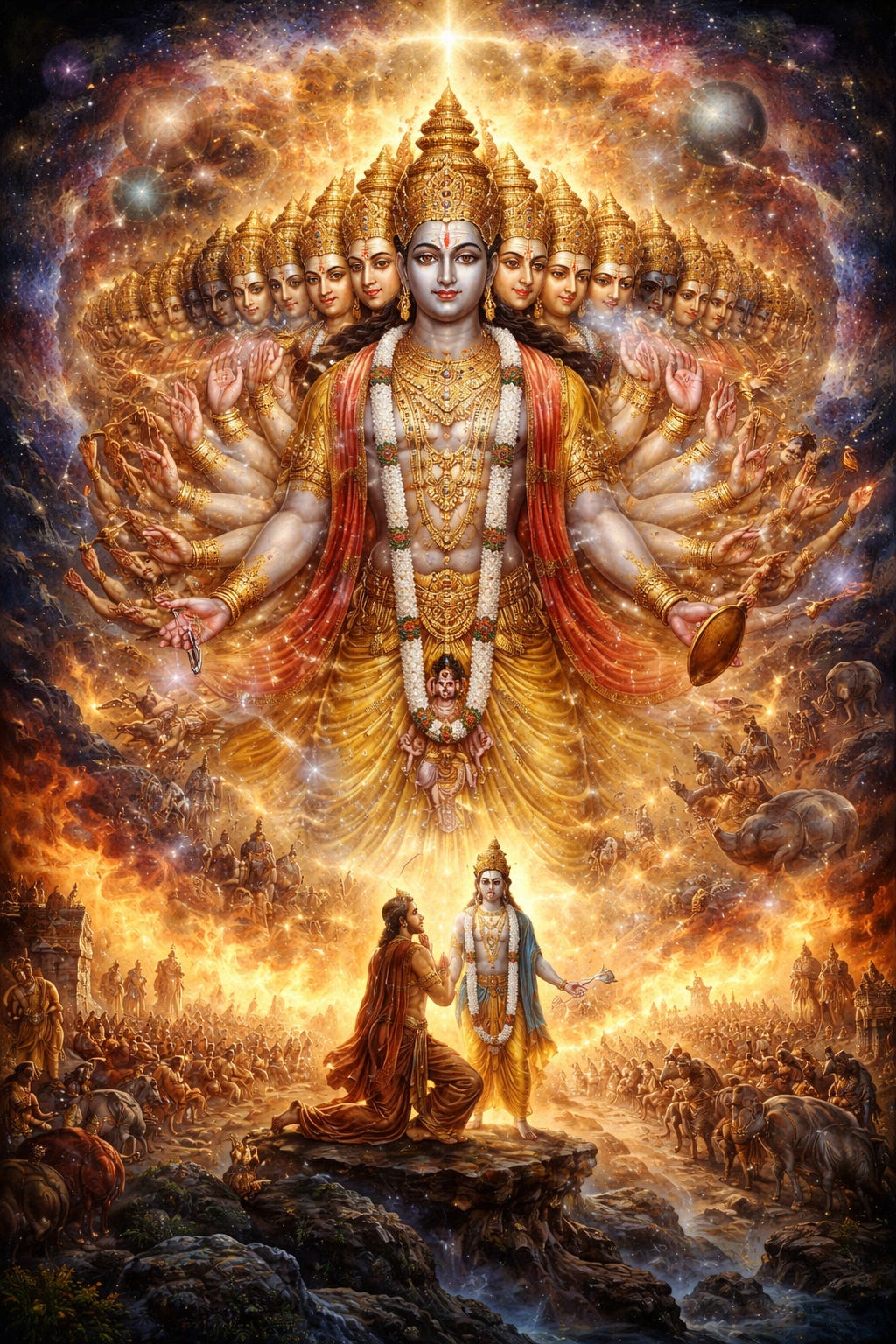
This is why the same film or artwork can devastate one person and leave another completely unmoved. As we all know, Duryodhana did not recognise that charge because he was not attuned enough to detect the charge of Virat Rupa. The charge is there. But not every receiver is tuned to receive it. Which brings us to Wilson’s most important contribution.
Wilson’s central argument across his entire body of work — from The Outsider in 1956 through Mysteries in 1978 and beyond — is that human beings operate at a fraction of their perceptual capacity almost all of the time, and that this is not a fixed condition but a variable one [which I had tried to explore in my book Anugami through Avyakt before I discovered Wilson].
He was fascinated by what Abraham Maslow called peak experiences — those moments of sudden, inexplicable aliveness when the world becomes intensely real, when meaning floods consciousness, when the ordinary becomes extraordinary. Maslow observed that nearly all human beings report such experiences, but most people dismiss them as anomalies, pleasant aberrations from the grey norm of daily life.
Wilson argued the opposite. The peak experience is not the aberration. The grey norm is the aberration. Our ordinary flattened consciousness is the artificial state — produced by the brain’s energy-conserving habit of filtering, dimming, and automating. The peak experience is what consciousness looks like when the filter is temporarily removed. Like when I was on the train and felt vacant, but was then captured by a moment from a few days ago, through retro-imagination — or what we might call retro-recollection (as Proust recalled everything in Swann’s Way) — and formed a beautiful poem.
“We are like people who have forgotten how to eat properly. We survive on scraps, and when occasionally we sit down to a real meal, we are overwhelmed — and then go back to our scraps and call the meal an exception.”
Wilson identified a specific mechanism he called the St. Neot Margin — a threshold below which consciousness drops into a kind of grey nullity, a flatness in which nothing seems fully real or meaningful. Most people, he observed, spend most of their lives at or below this threshold. The robot is in charge. The human is asleep. For example, I tell my friends: do not use robotic vacuum or aid machines to clean your house. It seems like an ordinary and anti-evolutionary thing to say, but if you read between the lines of my provocation, you will understand my meaning. I will explain further in later paragraphs using Kirlian photography, but first let me deal with Wilson.
He also identified the triggers that push consciousness back above the margin — that wake the human up. Danger is the most reliable. Real, physical danger instantly clears the fog. A near-miss accident, a sudden shock — and for a few moments everything is vivid, real, saturated with meaning. The problem is that we cannot arrange to be nearly killed on a regular basis. We had a small accident a few years ago on the highway. The car was wrecked. I was not even aware of the collision. I was hyper-aware of the situation beforehand, perhaps. When we reached the curb and hit, just before that, exiting the motorway, I had a vision of some loud noise. I even mentioned it to my wife [she was driving], but she said, “It’s raining, so you are hearing it.” But that noise was precognition, hyper-awareness.
Art, when you see it, gives you that same hyper retro-cognition. Wilson argued that great art is the civilised substitute. Great art is a controlled emergency — something that creates, through beauty, moral complexity, emotional resonance, and the skilful manipulation of anticipation and release, the same neurological conditions that danger creates. After the collision, I invented Devratha. This kind of invitation wakes the brain up. It forces consciousness above the margin. Then it creates something like Potato Eaters or The Godfather’s theme music. It makes the person in the seat feel, for the duration of the experience, genuinely alive.
This is why great cinema, great art, or great literature (like Don Quixote) does not merely entertain. It briefly transforms the person watching or reading it. They emerge from the cinema slightly differently from how they entered — their perceptions sharpened, their emotional range expanded, their sense of what human life can contain enlarged. This is not a small thing. When Quixote charges his lance at the windmills, we feel something great about his whimsical approach. Wilson believed art was one of the primary mechanisms by which human consciousness evolves.
We can now answer the original question with some precision.
A film with a good plot but no soul engages only the brain’s narrative cortex — the region responsible for processing story structure, causal logic, and character motivation. This is useful. It can produce interest, curiosity, even mild pleasure. But it does not penetrate the deeper layers or reach the Cabalistic Kether. It does not reach the amygdala, the emotional core. It does not trigger the mirror neuron system that allows one person to genuinely feel another person’s experience, as Arjuna felt the Virat Rupa. It does not manipulate the dopamine system through delayed, earned payoff. And it carries no Lethbridge charge — because it was made without genuine emotional investment. It carries no Potato Eaters’ terroir-touch — which I would describe as having no genuine taste of the exact soil, the exact weather, the exact place. Untranslatable by anyone who wasn’t there.
The brain is extraordinarily sensitive to authenticity. Not authenticity as a style or an aesthetic choice — but authenticity as a quality of the experience that produced the work. When a director is genuinely afraid, genuinely in love with the material, and when the artist is genuinely wrestling with the moral complexity of what they are depicting — that quality leaves traces in the work. Traces that the viewer’s brain detects subconsciously, even when the viewer could not articulate what they are detecting. They can trace that charge of the artist, which was documented by Russian professor Semyon Kirlian — though I believe it was discovered by the Indian sages quite long ago, when they were writing such epics as the Mahabharata or the Bhagavad Gita, where the same kind of aura had been described.
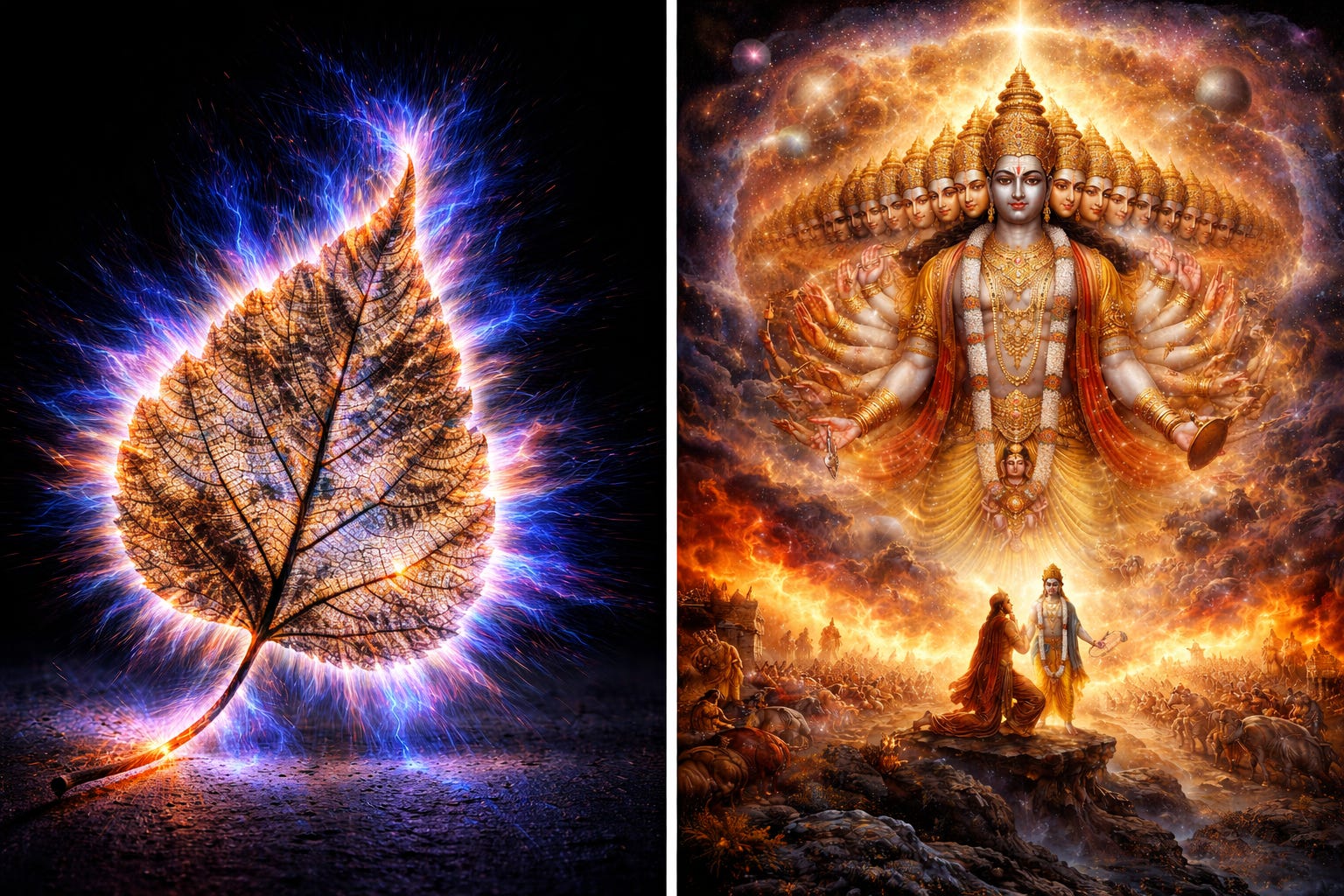
https://commons.wikimedia.org/wiki/File:Kirlian_Photograph_of_a_Coleus_Leaf_1980.jpgConversely, when a film is produced primarily as a commercial calculation — when every choice is made by committee, when the emotional beats are engineered from a formula, when no one involved was ever genuinely moved by what they were making [like never having been touched by a stone-emotion] — the brain detects this vacancy too. The stone is uncharged. There is nothing to receive. The viewer may follow the plot. They may even enjoy it — even follow the path of the brush — but in a mild and forgettable way. They will not be changed by it. They will not think about it in the bath three days later. They will not feel it rise in their throat when they hear a particular piece of music.
This is the difference between craft and art. Craft is the execution of skill. Art is the transmission of charged human experience. Both require skill. But only art requires that the maker was genuinely alive when they made it. Kirlian’s photographs from the early twentieth century offer much proof of the aura.
I want to dedicate a few paragraphs to the events of the Bhagavad Gita. Right before the battle of Kurukshetra, Krishna revealed his Virat Rupa — the Universal Form — to Arjuna. He showed that he is the entire universe itself. Arjuna saw the sun, stars, all gods, and even past and future moving inside Krishna. The Bhagavad Gita (11.12) describes the brightness as resembling hundreds of thousands of suns rising at once. This aura behind his head — the aura behind great sages — has been transcribed into many literatures throughout Eastern and Western philosophy. In India, the halo (Prabhamandala for the head, Prabhavali for the full body) may date back to the second half of the second millennium BC — figures on pottery from Daimabad’s Malwa phase (1600–1400 BC) already show halos around what appear to be sacred figures. This predates similar iconography in Christianity and possibly even Buddhism, which Kirlian later tried to prove through his photography. Now even science has proven that bioelectricity can be produced by the human body and other objects. Every time I recite those verses from the Gita, I feel that sensation in my body. The ancient Hindu artists were essentially depicting bioelectric and photonic fields around enlightened beings thousands of years before Kirlian invented his camera. This halo of Krishna at Kurukshetra is one of the most cited phenomena in Western philosophy.
Wilson introduced the concept of Faculty X [I was trying to write about it as Avyakta before I knew Wilson] to describe a latent human capacity — present in all people but fully active in very few — to feel the complete reality of something not physically present. To step so fully into another time, place, or consciousness that the gap between self and other temporarily dissolves.
He drew examples from literature, history, and the paranormal. Proust tasting a madeleine and suddenly inhabiting the past so completely that it was more real than the present. The historian Toynbee standing on a battlefield and feeling, in a sudden overwhelming flash, the reality of the men who died there centuries before. The musician who, while performing a piece of Beethoven, briefly becomes a conduit for something larger than their individual consciousness.
Faculty X, Wilson argued, is not supernatural. It is the natural operation of human consciousness at its full capacity. It is what we are capable of when the robot steps aside and the full depth of the brain’s perceptual and empathic machinery is engaged.
Great art activates Faculty X. When you watch Michael Corleone’s face in the baptism scene of The Godfather — that extraordinary sequence where a man is literally renouncing evil in God’s name while ordering the slaughter of his enemies [it gives me goosebumps every time I watch this scene] — and you feel something genuine move through you, something that recognises in his damnation a human truth about what ambition and loyalty and love can cost — that is Faculty X. That same faculty works when you see Potato Eaters too. You are briefly living inside a reality that is not your own. You are feeling what it costs to become a monster, from the inside — or feeling what it is to be a humble creator from ordinary existence.
This is what mediocre art cannot do. Not because it lacks technique, but because there is nothing in it to activate Faculty X or stone-emotion. The characters are not real enough. The emotional charge is not there. The brain encounters the work, processes it, and files it. Faculty X never stirs.
We began with a simple question: why is some art great, and some not? We have arrived, I think, at an answer that is both scientific and philosophical, both neurological and mystical — which is perhaps appropriate, since the question itself lives at the border between those territories.
Great art is a charged object — a Lethbridge stone pressed full of genuine human experience by a creator who was fully alive when they made it. It carries the emotional energy of its making the way a battery carries electrical charge. It waits for a receiver.
The receiver is a human brain in a state of sufficient openness — a brain that has, at least temporarily, allowed the robot to stand down, that has lifted its perceptual filter, that is willing to be surprised, challenged, morally unsettled, emotionally ambushed. A brain that is, in Wilson’s terms, operating above the St. Neot Margin — as mine was when I was suddenly struck by that ball of wind earlier.
When charged object meets open receiver, something passes between them that has no precise scientific name — though neuroscience can describe its components: the dopamine surge, the amygdala activation, the mirror neuron cascade, the limbic resonance. Wilson would call it the expansion of consciousness. Lethbridge would call it the replaying of stored emotional reality. A filmmaker might call it the moment when the audience stops watching and starts feeling.
All of these descriptions are pointing at the same phenomenon. The phenomenon is real. It is measurable, in its effects if not in its mechanism. And it matters — not merely as an aesthetic experience but as a human one.
Because if Wilson is right — if great art is one of the primary mechanisms by which human consciousness evolves, by which we briefly operate at our full perceptual and empathic capacity — then the question of what makes art great is not an academic question. It is one of the most important questions we can ask.
Every time a great film is made carelessly. Every time a studio overrides a director’s vision in favour of a commercial calculation. Every time a composer is replaced with a formula. Every time an actor is asked to perform an emotion they do not feel — a Lethbridge stone is left uncharged. The Virat Rupa is missing.
And somewhere, a human brain that might have woken up remains asleep.
Principal Sources and Influences
Bhagwat Gita
Colin Wilson — The Outsider (1956); Mysteries (1978); Beyond the Occult (1988)
T.C. Lethbridge — Ghost and Ghoul (1961); A Step in the Dark (1967)
Abraham Maslow — Toward a Psychology of Being (1962)
Andy Clark — Surfing Uncertainty: Prediction, Action, and the Embodied Mind (2016)
Francis Ford Coppola — The Godfather (1972); Notes on the Godfather

No comments:
Post a Comment