
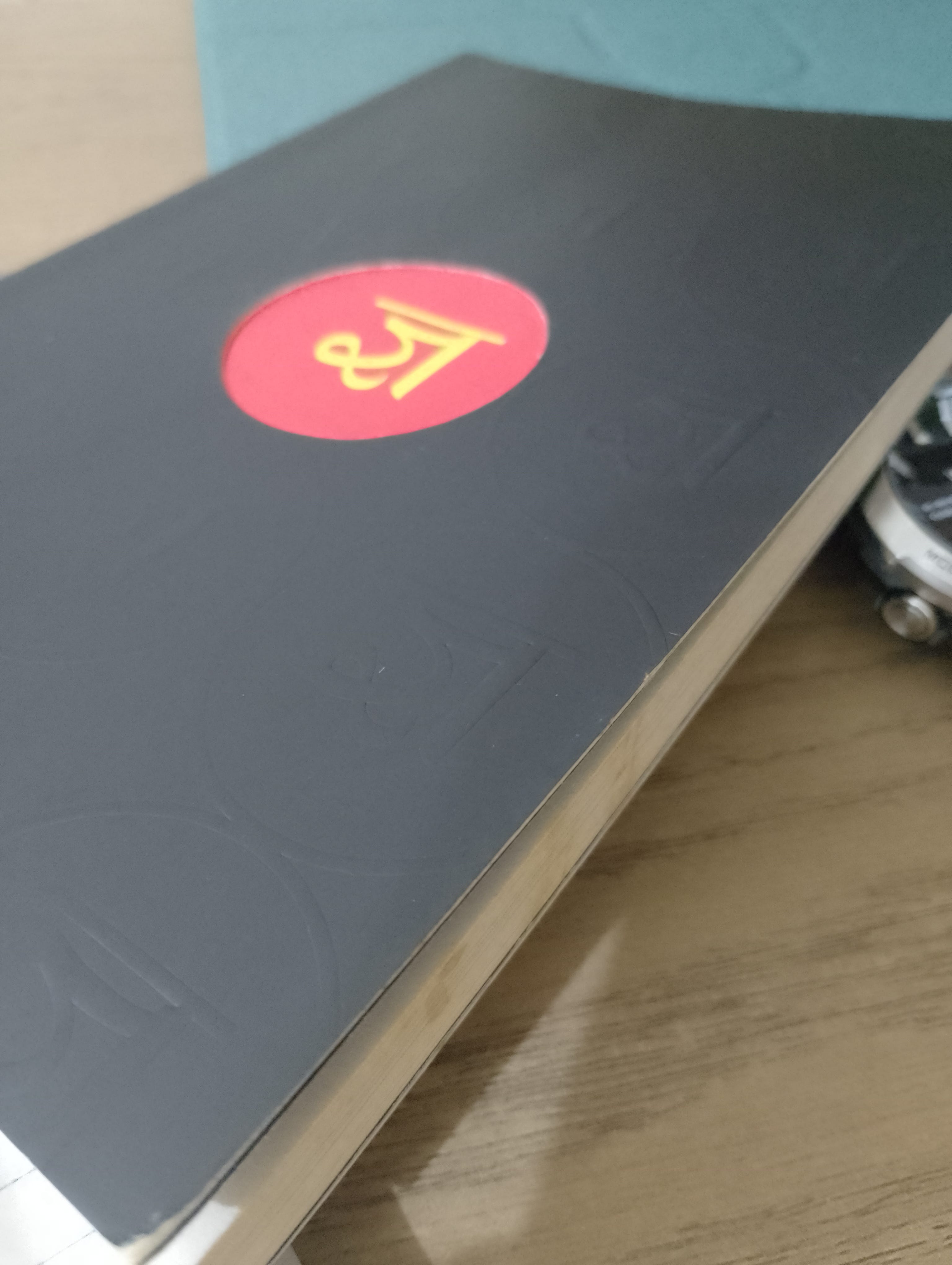
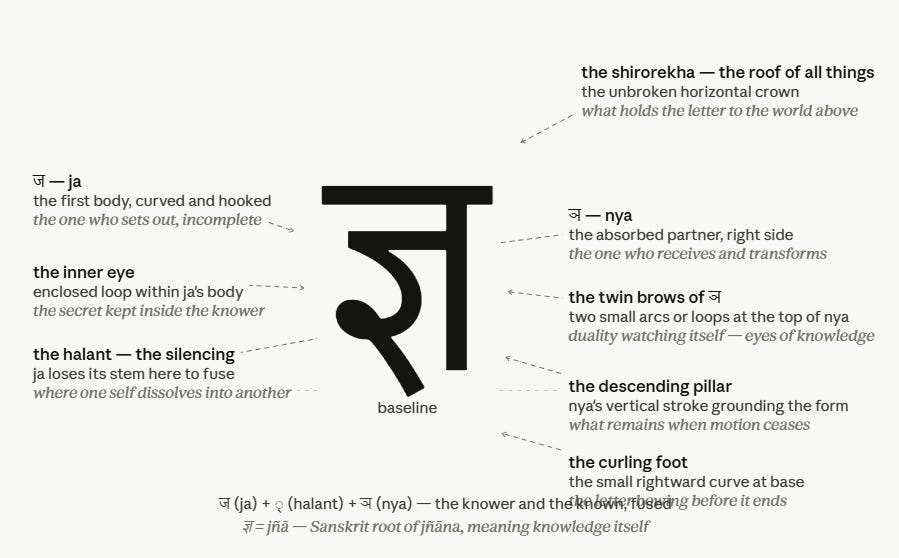
After a long time I had been watching that letter ‘Jñā’ with a curious mind. I was first thinking — wow, what a letter. Is that what I am watching, a letter? My eyes were tracing its lines from top to bottom. I find it familiar instantly but after I gazed longer, it becomes more alive, but its aliveness gave me the sensation of nauseating. One moment I was familiar with the letter itself and other moments I find it unfamiliar and distracting. Suddenly the curve around its edge becomes familiar but its precise moment of bending becomes alien. First the inner eyes — it started to broaden inside my pupils giving me a kind of strange anandamide; twin brows of the middle part of the letter arose and sat between my gaze, unfolding its genuflect-curling-feet which I somehow imagined like a girl putting her legs one upon another, showing its profoundest beauty, and gradually the upper horizontal lines started to add its crown like a king, hugging, folding, nauseating its inner eye.
Now, this moment, there was no room left for breath; I started feeling dizzy seeing the fullest form of this Jñā. In the middle of this hallucinogenic realization of the letter I bent my legs to imitate its Halant2 — where, you can clearly see, Ja surrenders its silence and becomes descending pillar of the letter. I sat there for a minute, imagining I am hanging on its Shirorekha3 like a little monkey, enjoying with collective nausea. The last part of the coil becomes infinity and its strangeness becomes more grave. The most interesting part while I was having this thistle on my senses is that Jñā’s self-evident reality started to feel like agreed-upon reality — the same reality that gives me vertigo and nausea while I stare outside that moving bus, based on just black ink and some nonsensical lines. Is it not nonsensical lines created by human knowledge? It’s just lines and curves, nothing more, I thought. Now the line was merging and I could no longer sense its whereabouts on that book cover. It was not dissolved in a metaphysical way in that cover but its ‘is’-ness was confusing. I felt at some point I have never seen this letter before, and that alienating from the letter itself hounded me like a feral dog. When you watch something casually you find it interesting but when you see it ‘through its nakedness’ then it looks bizarre and absurd. Now everything started to separate from its root, dismantling itself from the letter’s geography. Curling feet, inner eyes, halant — everything was bending its head and (un)showing the letter’s bizarre dance before my eyes. In Devanagari4 script every letter hangs on its upper line (Shirorekha) and makes it complete. For example, if I write Ka5, the first letter, I make a vertical line (read footnote to see the structure of the letter) and then on the left side I make half O and complete the other half of the same O with little room left on the right edge and, finally, complete it with the upper line — that is the process of making the agreed-upon hallucination of literacy. Even for other languages it’s the same process; they make nonsensical lines and call it literacy.
Now, alter this process and start from the top line — it would look like a hanged man. You will never reach the end of the letter. I became too distracted in between this process because I tried to break the collective hallucination of human being, this undoing of ‘thisness’ of perceiving-order to make meaning — we can call it pragmatic dissolution of order. I was feeling tired and sleepy yet the letter demanded something immediate from me. What was that? That was the demand from the letter itself. I see it more and more and it becomes ocular cannibalistic. You ever realized that if you stare too long at the sun it starts to hurt your eyes, it starts to eat your vision — it is the same; while I was staring and trying to understand every line of Jñā — its form, Ja, Shirorekha, Halant, and curling feet — it squeezed my veins and says: ‘you don’t know my actual form, ultimate joints of my transcendental, hygienic, singular blob.’ What happens if the body starts to read philology? I was not trying to imitate, sitting like Halanta, but I was being read by its vowel. I sat like the final line — Halanta — crossing my legs; but, you know, in Devanagari, every Halanta is the king of the sound, it makes the silent utter, but every utterance and every bend is made up to fulfil civilized literacy — that which gives me nausea. I don’t have a problem with letters but with their sound. Most of my writings are occupied by this Double, the duality of arc, bimorphic speculations, and what I wanted to see is just Oneness — the merge of every vowel, reality, tables, trees and oranges and twin eyes into one. While watching Jñā and as it started to dismantle its body, it started to produce a strange hum, that which was biochemical anandamide (Anandamaya6 from Sanskrit) — I was listening or seeing from its shape, not its sound anymore. I was defamiliarized with Jñā. Everything is not ending here. Can you not see that descending line from the Shirorekha, like a monolith — I saw that as a linga7, a male organ, producing the entire universe at once, not from its sound or vowels but with its stepping into the void-ness I was waiting. There stands Shiva, holding His giant linga, and beneath, kneeling Halanta, accepting everything, making its tongue outward — this is how letters become monolith of desire, love, and original meaning without its make-up of collective agreement.
Jñā reminded me of the French letter with its accent aigu, and other symbols on top. I even bought a French dictionary at that time of my youth (the main reason was I was reading Being and Nothingness for the first time ever and wanted to know the first-hand meaning of some French ideas), and pondered a good long time over it — gazing upon it (not to confuse with reading) — to satisfy the tenderness that letters produced. Later that year I joined university to study French language, but never completed. And upon seeing that Jñā the other day my love of the letter came back to me. If everything is a collective agreement between Me and the World then how do we even define or defend happiness, freedom, or simply seeing the realm outside of this being? Are we trapped in the meaning? Or are we trapped with its definition of being part of reality? Jñā lifted its sombre ink and spaced its involuntary is-ness towards my perception. In his 700-page long treatise he just argued one thing: consciousness is not a thing but a ‘lack.’ What kind of lack, then? When you stare like this at one letter and see the hole instead of structure — man-made meaning — then your consciousness will not just be Nothingness; it becomes part of its ‘meant-knowledge.’
I wanted to learn French but I abandoned the idea of studying it after three semesters. One fact came to my mind now. While I was studying there was this girl in my class who always sat in the first row, holding her pen to her lips, pondering over French accents, maybe, but in the recess I said to her that she looks like ç — beautifully capturing its essence. She was delighted but she never asked the idea behind it (after all she was just learning language, but I was learning beyond language). You know what holds beneath its ç? The cedilla — the little tail, from the Spanish zedilla, little z — hangs under the C and changes its sound entirely: softens it, opens it, makes it say S instead of K, spreads it. People learn to pronounce it by curling their lips like French but I never tried it, as I was satisfied by its ‘look,’ not the sound. I meant that you have that soft curve — emotions, original sounds — underneath your beauty, but she never learned what I meant; she went on for collective hallucination instead. Basically I dropped the classes, but in truth they had failed themselves to understand this beyondness of letters. I never see words, I see body, I see cosmic inside it. I never try to learn words but try to learn their curves and bends. I was fascinated by a cover song at that time by Florina Perez — ‘All of Me’ French Cover. I never understood the lyrics and never tried to, but the sounds of words and letters was tender. I am not a sage and I don’t know — even learned sages from Indian philosophy don’t know — the meaning behind OM, and I found that unknown meaning behind Florina’s utterance.
I even bought a German dictionary to study German words but I didn’t even tear its plastic cover.
Where I work there is this one elderly man who listens to Chinese songs all the time. One day I asked him: do you like Chinese songs? He said yes. So you speak Chinese so well? He said no. That made me perplexed about this insane desire of literacy called — mass learning hallucination, the greatest human beings have ever learned. Later in my life I was fascinated by Castaneda’s ideas. Let me add first what his philosophical ideas are about. His philosophical device Don Juan Matus provokes this agreed-upon description of reality. When I stared at Jñā I didn’t look for a letter, I never did. When I told my friend that you are like ç, I meant not for her outlook but for her internal vortex that stirred upon me. When I first read Nietzsche I never looked for his philosophy; rather I pursued his suffering — same like Jñā’s suffering — to show its true meaning and sound. It has always been in debate whether Don Juan of Castaneda’s was real or just a character he created to give his inner sound, but the originality of his ideas always pressed upon me. Don Juan always tried to stop that external pollution that which was preventing one from seeing the rawness of understanding, of Jñā — which also means Knowledge in Sanskrit. This elderly man, you see, he is old and dirty. His room is filled with broken nostalgia but what he was doing interested me. He stinks but I smell his ‘narration-off’ and find it satisfying. When the elderly man said I don’t speak Chinese and I don’t understand it — then this concept of understanding reality through agreement becomes more important than anything. He is simply trying to undo this description of reality — mass human hallucination of learning and literacy. The elderly man was trying to listen, not simply to Chinese, but to the before-ness of language. When he finds this pre-semantic enough satisfying, he always says, ‘I need to sleep and dream.’ I always wonder what he might dream — Jñā, ç or something else! Castaneda summarized Don Juan’s entire teaching in one beautiful sentence: ‘Stop the World.’ I will never stop watching letters but I always watch their edge and their centre where no human sound has yet reached; that’s what Don Juan’s ‘stop the world’ means — stop the agreed-upon description of it and feel enough to see what’s really there to digest. Every day I suspect my own existence seeing this growing ‘agreed-upon thickness’ in humanity; they believe only in seeing description followed by traditional meaning-makers. What will be left if we still trust in those layers of thickness they have carried in our faulty history? Whenever I entirely removed the semantic layer from its skin then I was able to see through its corset — the real beauty underneath it carries — that is what Castaneda was teaching.
And there — the crucial point begins. How to see this ‘unseen’ is-ness hiding behind the historical corset?
I started, then, visiting Pashupati8 and experimenting with forbidden substance to avoid ‘ordinary perception of agreement’ — this Jñā’s inner agreement — hoping that it would subdue my perception of duality I was troubled by in the year of my Le Grey Bastion period. No avail it did, but I learned something new on the way, and that newness gave me another illness of seeing too much and too deep — like Jñā, reality started to get a better idea but it left a permanent mark on my forehead that says: ‘underneath this reality nausea hides and grows.’ The burning ghats9 of Pashupati where I could see sages smeared with ashes all over their body, naked roaming around temples, uttering hymns and smoking ganja — people see them as mere spectacles but I saw them inside their skins, their ‘dead-penis’10 which hangs there like they have forgotten all the desires of reality, just a glimpse of Castaneda’s teaching alive. When I met Roquentin immediately after encountering with Meursault (later I put him as a sub-character in one of my stories), I had no idea Sartre would be my lifelong reading. Whenever I used to see such sadhus in this manner I used to stare the way Roquentin used to stare at the chestnut tree — being lost, trying to unearth the vertigo it hides. I couldn’t agree upon the ‘agreed-upon agreement’ anymore; I became too aware of ‘seeing too much.’ I used to sit there on the ghats and see the burning dead body — cremation — and it reminded me of Meursault, whom society executed not for being a murderer but for committing the crime of ‘failure of agreement.’ ‘What a farce we have created so far,’ I thought. I never negated the system but how it is creating meaning — that is what I am criticizing. Sartre created one hell of a conscious battlefield in Being and Nothingness; the freedom of being a being I was trying to etch into my bones too. Somewhere I mentioned that Being and Nothingness is like an existential Gita for me.
I was then 19 when I started to expand my knowledge with Western philosophy, holding slightly behind my initial reading of Osho, Krishnamurti, Vedas, Gita and Nepali literature. I got my hands on Zarathustra ever first through Osho’s reference in his lecture series ‘The Books I Love,’ where Osho praised this Zarathustra — and until then I didn’t know about Nietzsche or his work. After studying Thus Spoke Zarathustra, taking many months and days, I wrote a story about a man called Glasvko, inspired by his Zarathustra. It was a short story but had the feeling of this mountain man — Zarathustra. I was immediately drawn to Nietzsche’s aphoristic style and poetic prose. After that, in that period which I am calling Le Grey Bastion11, I read most of his books except The Will to Power and Genealogy of Morals. What did I learn? Actually I learned nothing, because there is nothing to learn from him, as Osho said: ‘Nietzsche is not a philosopher, but more than that’ — and he was a ‘dynamite’ to me. Nietzsche was right calling himself dynamite because I learned from his ruin, not from his decorative aphorism. Seeing Jñā that evening it was clear that I am not a part of this collective hallucination — I am more than Shirorekha, more than agreed-agreement with reality, more than what Nietzsche called Übermensch — peeled man of reality.
I always recommend people to read books and philosophy to understand life, but when I saw that unknown spiral surfing through Jñā, I found nothing but that letters are civilized collective agreement — then how does reading serve the ultimate conscience I was recommending? I was wrong too. I started reaching for every word served by this phenomenal last script of Devanagari, but recalling words does not mean anything as its rawness I have already seen, and meaning collapses under its own tiresome weight — that shape just tamed the meaning of the world behind the fluorescent peeling of actual seeing. When I finally peeled off the foreskin of Jñā, I saw nothing more than beauty, the reality of the non-letter, civilized literacy. I no more recommend any letters to humanity. But it’s not finished yet.
I started to axe down its lines and what was left was the empty space before the letter itself — holding its trace of ‘convey-the-meaning’ — which now becomes, what I call, Jamais Vu: the moment the meaning goes to Nothingness. For a few quiet seconds I saw every tonal inside Jñā that man ever named, even that which doesn’t start from Jñā — literature, philosophy, my hands, my voices, trees, tables, oranges, everything was circling this Jñā’s feral scribe. The categorization — this is a letter, this is a fruit, this is a hand, this is a philosophy — that categorization is what produces separateness. I can only teach you this: ‘stop it,’ don’t try, as Bukowski once said.
Now I am too tired even writing this. And the last thing — Nagual, I believe, is the OM before it is pronounced. What does it feel like to have that ‘before-tonal’ conscience inscribed into the Jñā, Roquentin’s chestnut tree, or the nausea I have? It was not my intention to see the unseen or feel the letter or something no-letter — but its edge was nauseating for me.
The last conjunct letter of the Devanagari script, formed by joining ja and nya. In Sanskrit, jñā carries the root meaning of knowing or consciousness — not knowledge as information but as direct apprehension.
A diacritic mark in Devanagari placed beneath a consonant to suppress its inherent vowel sound, creating silence within the letter. The king of silence — it makes a sound by removing one.
Literally 'head-line' in Sanskrit. The horizontal line running across the top of Devanagari letters from which each character hangs
The script used to write Sanskrit, Hindi, Nepali and several other South Asian languages.
Ka (क) is the first consonant, which begins the consonant series organized by where in the mouth the sound is made — gutturals first, then palatals, then so on. So Ka leads the consonants but not the script entire.
Anandamaya from Sanskrit: bliss-body, one of the five sheaths (koshas) of consciousness in Vedantic philosophy. Anandamide is the endocannabinoid molecule discovered in 1992, named after the Sanskrit ananda (bliss) by its discoverer Raphael Mechoulam — a rare moment where neuroscience acknowledged what Sanskrit already knew.
In Hinduism, the sacred symbol of Shiva — simultaneously a male organ and an abstract pillar of pure creative energy erupting from formlessness. Not merely phallic but cosmological: the axis around which existence organizes itself.
One of the oldest Hindu temples in the world, situated on the banks of the Bagmati River in Kathmandu, Nepal.
At Pashupati's cremation ghats specifically, the steps lead directly to the Bagmati River where bodies are prepared, burned, and the ashes swept into the current. The word carries no euphemism — the ghat is where the living bring the dead and the dead become river.
The meaning behind this is: The organ is there, anatomically present, but its entire narrative — desire, pursuit, pleasure, reproduction, conquest — has simply stopped running even they sat their in naked position to worship Shiva.
My private name for a period of intense philosophical reading and searching in early life.

No comments:
Post a Comment